Dashboard
The dashboard serves as your central hub, offering an at-a-glance overview of your colleagues, company values, performance management activities, and other insights. Designed for efficiency, it allows you to navigate the platform seamlessly and prioritise your activities with ease.
- Chapter 1: Introduction to Main Dashboard
- Chapter 2: Roles and Permissions
- Chapter 3: Setup and Configuration of My Dashboard
- Chapter 4: Using the Main Dashboard
- Update Banner Images
- Using the Timeline
- Custom Widgets
- Activating Standard Widgets
- Using the "My Colleagues" Widget
- Give and Receive Kudos
- My Performance Status
- Our Company Values
- HR Processes
- Chapter 5: FAQs
- Chapter 6: Glossary
Chapter 1: Introduction to Main Dashboard
Overview of the Main Dashboard

The Main Dashboard is the starting point for users within the system. It brings together important information, updates, and actions in a single location, making it easy to stay informed and complete tasks efficiently.
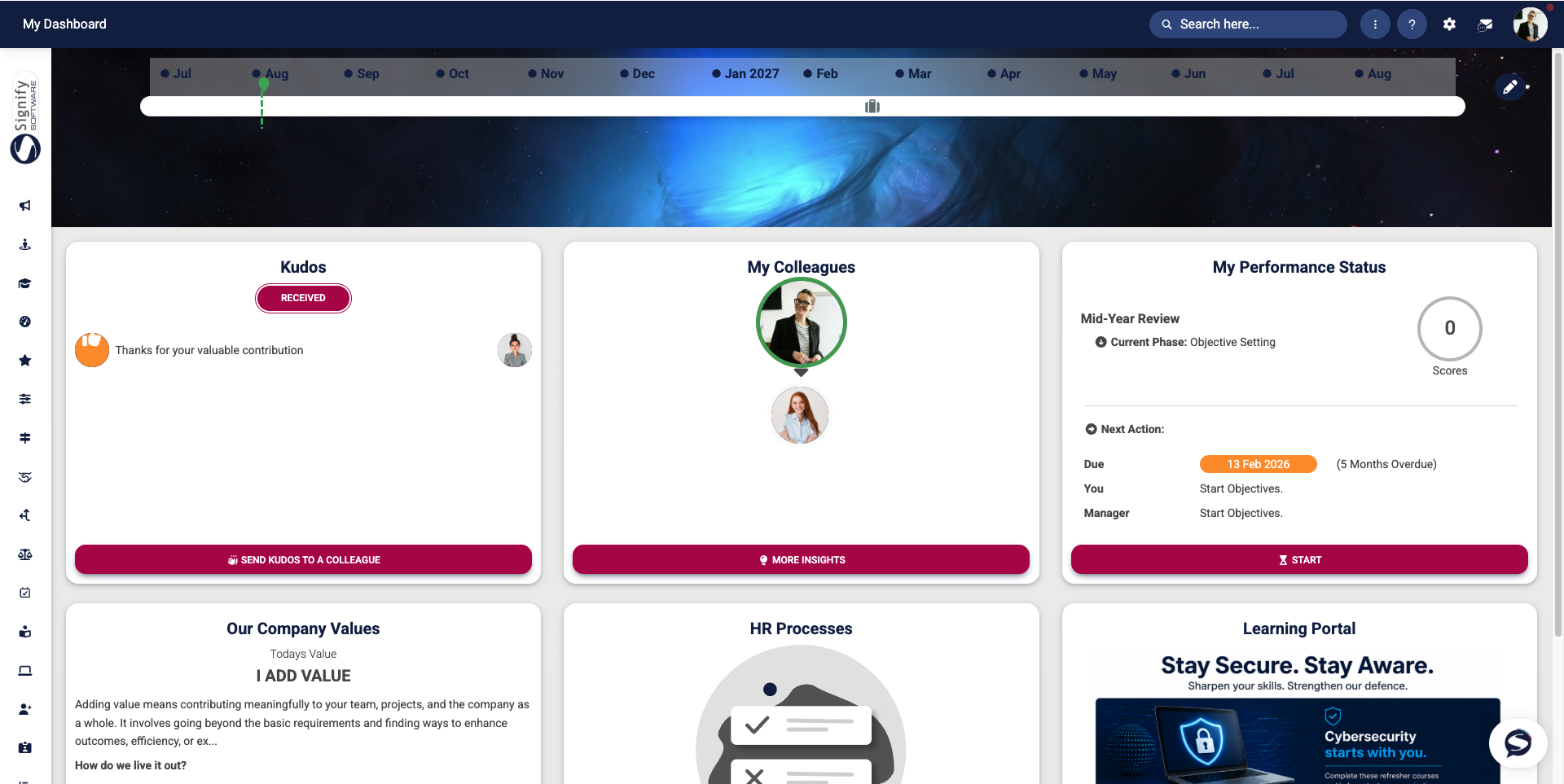
At a glance, users can view upcoming milestones, recognise colleagues, monitor performance activities, access company information, and manage outstanding HR tasks. The dashboard is designed to provide quick access to the information that matters most, reducing the need to navigate through multiple menus.
Dashboard components
The dashboard consists of several widgets, each designed to provide relevant information and quick access to key features. These include, but are not limited to, the following components:
- Timeline
- Carousel banner
- "Kudos" widget
- "My Colleagues" widget
- "My Performance Status" widget
- "HR Processes" widget
- "Our Company Values" widget
- Custom dashboard widgets
These will be discussed in more detail in the following chapters.
Benefits of the dashboard
The Main Dashboard helps users:
- Stay informed about company updates and announcements.
- Track important milestones and employment-related events.
- Recognise colleagues through the Kudos feature.
- Monitor performance activities and review progress.
- Access key information quickly from a single location.
- Complete outstanding HR tasks without navigating through multiple system areas.

Purpose of the Main Dashboard
The Main Dashboard feature offers a personalised, single entry point to the HR platform, allowing users to see what matters most to them at a glance and act swiftly. It combines milestone information, company communications, people insights, and outstanding HR tasks into a single view, reducing the need to navigate multiple menus and helping users stay on top of their responsibilities.
The dashboard highlights key items, including a timeline showing employment anniversaries and personal milestones, a carousel banner for organisation-wide announcements or featured content, and a kudos widget to promote peer recognition. Users can quickly view colleagues and people insights, check their current performance status, and read the company values to reinforce culture and behaviour. Custom dashboard widgets enable targeted announcements or direct links to specific areas of the platform, such as an e-learning course, a frequently used form, or an internal resource.
Overall, the purpose is threefold: to inform, prompt, and connect:

The following pages in this chapter offer a closer look at each widget, explaining how they work, their role-based visibility, and how to configure them to suit your needs.
Key Features of the Main Dashboard
The Main Dashboard combines people, status, and communications into a personalised view, enabling users to scan, act, and navigate easily without searching through menus. Let us examine the key features and their functions.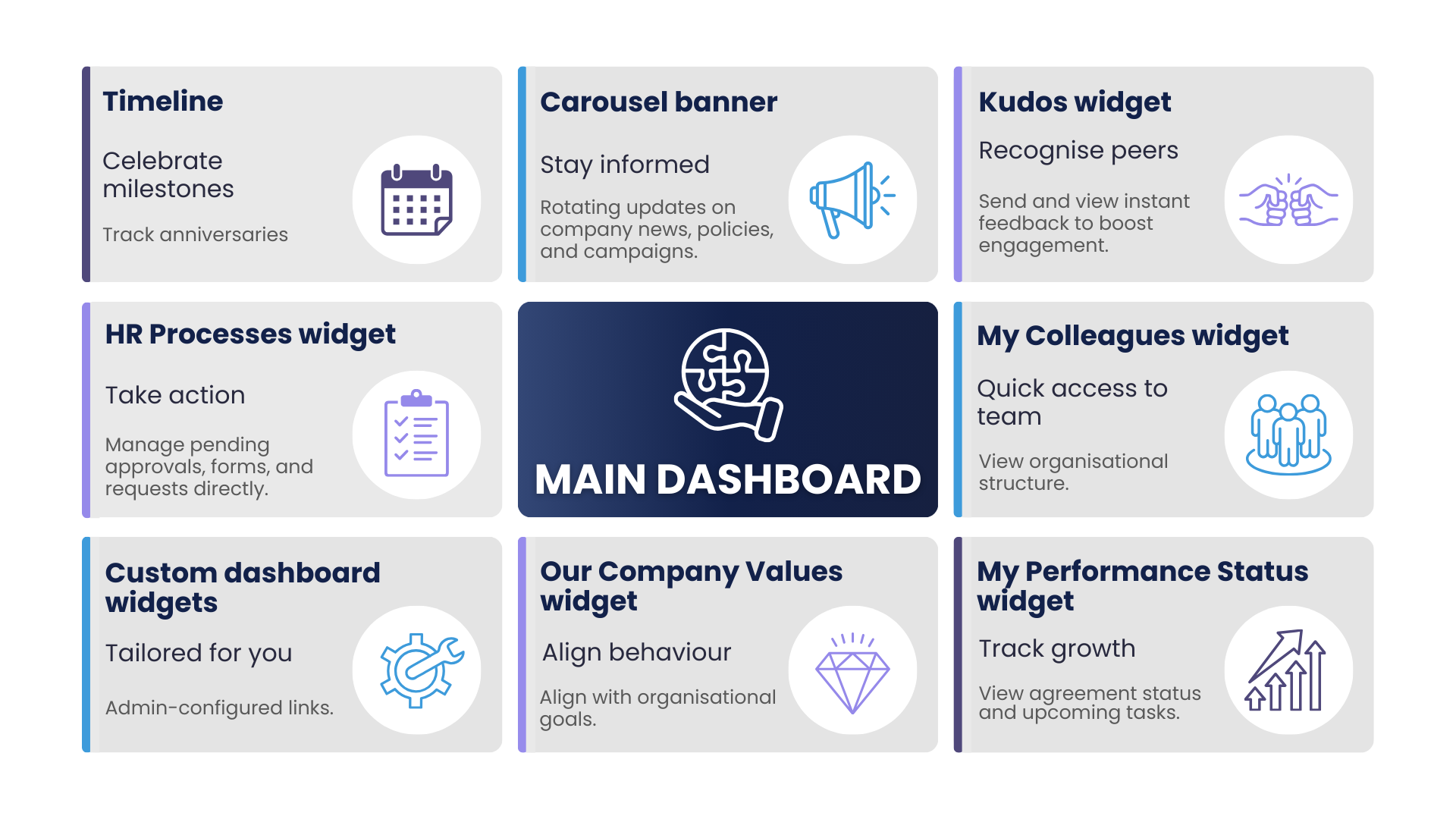
Timeline
The Timeline highlights some important employment-related milestones, such as work anniversaries and other significant events. This provides users with a visual overview of upcoming and recent milestones.
Carousel banner
Kudos widget
The Kudos widget helps boost engagement and highlights positive feedback without leaving the dashboard. It encourages peer recognition by showing recent kudos activity and providing a one-click option to send kudos to colleagues.
My Colleagues widget
The My Colleagues widget is a compact panel showcasing team members or reporting lines. It provides quick access to the organisational structure and offers additional people-related information and insights.
My Performance Status widget
The My Performance Status widget provides a summary of performance-related information, current agreement status, upcoming review dates, or pending performance actions.
Our Company Values widget
The Our Company Values widget is designed to encourage reflection and consistent behaviour across the organisation. It strengthens organisational culture by displaying the current value or behavioural focus, a brief explanation, and a link to the full values library or suggested behaviours.
HR Processes widget
The HR Processes widget displays outstanding requests, forms, approvals, and other HR-related activities that require attention. Users can track progress and complete tasks directly from the dashboard, helping them stay on top of their responsibilities.
Custom dashboard widgets
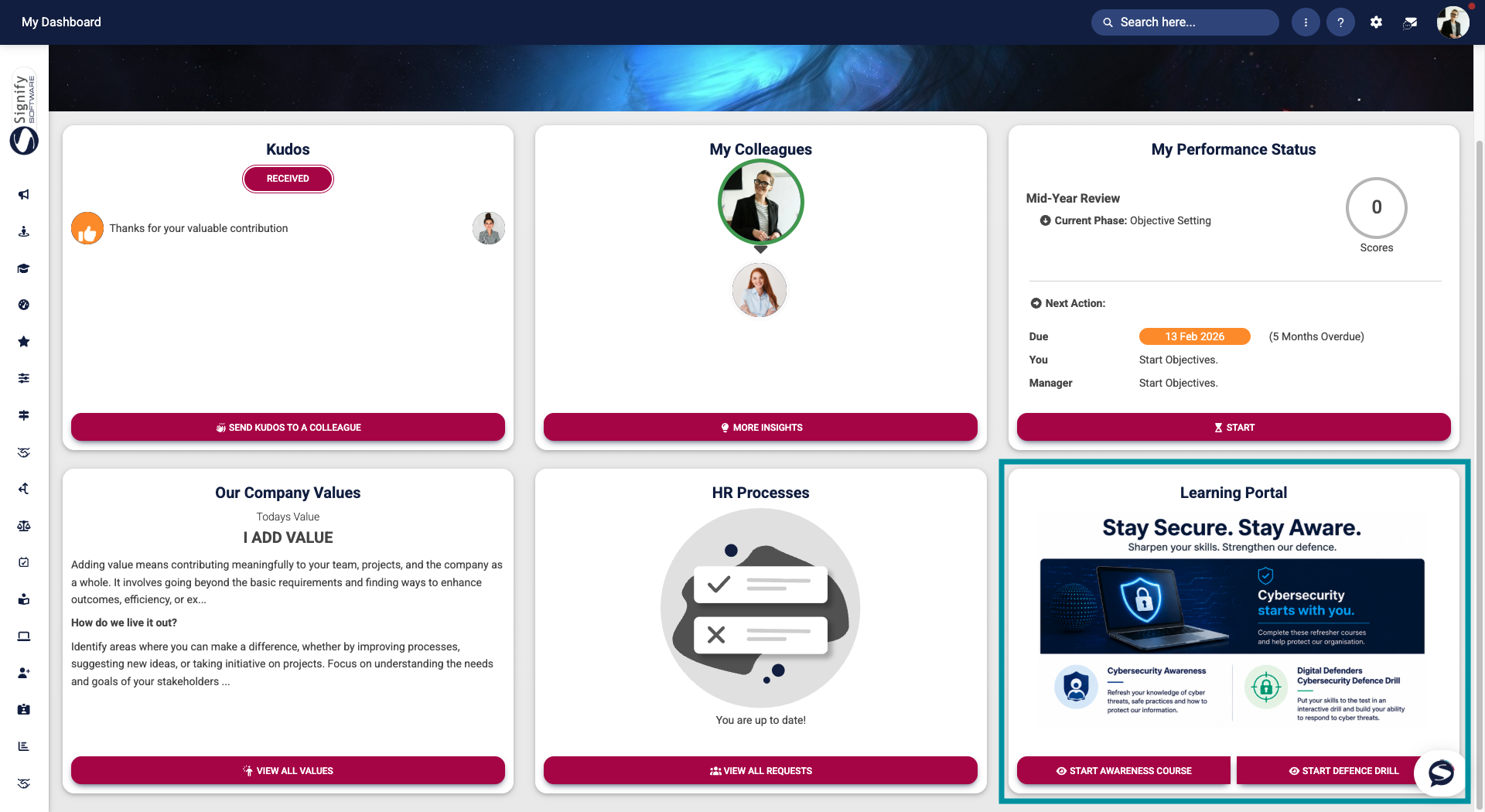
Custom Dashboard Widgets can be configured to display targeted announcements, important information, or direct links to specific areas of the system. Examples include links to e-learning courses, frequently used forms, and other commonly accessed resources. In the image below, the widget provides links to two e-learning courses for users to complete.
Chapter 2: Roles and Permissions
Employee and Managerial Roles
The Main Dashboard serves as a personalised landing page for users, offering quick access to relevant information, updates, and actions within the HR management platform.

The dashboard also promotes collaboration and engagement within the organisation. Through widgets like Kudos, users can recognise colleagues for their contributions, while the My Colleagues widget offers visibility of team members and quick access to people-related information. Employees and managers can view an overview of their Performance Status and navigate directly to their performance dashboard. Users can also stay informed through carousel announcements, company values, and customised widgets that link to internal resources, training content, or other important system areas.
Overall, the dashboard helps users stay informed, engaged, and responsive by displaying relevant information and actions in one easily accessible location.
Administrator Roles
Administrators are responsible for configuring and maintaining the content and behaviour of the My Dashboard to ensure it remains relevant and useful for users across the organisation. This includes:
- managing dashboard widgets,
- deciding which widgets are available, and
- setting up the information displayed within them.
Administrators may use the dashboard configuration to publish announcements in the carousel banner, define or update company values, configure HR processes displayed on the dashboard, and create custom widgets that link to important resources, such as internal documentation or e-learning courses. They also oversee role-based access and permissions to ensure users only see widgets and information appropriate for their role within the organisation.
Through these configurations and governance duties, administrators ensure that the dashboard stays a valuable and efficient entry point to the HR management system. Future sections in this chapter detail the configuration options and settings for each widget.
Chapter 3: Setup and Configuration of My Dashboard
Prerequisites for this Module
Before configuring the widgets on the Main Dashboard, several modules must be implemented for them to function correctly.
- Kudos
-
- Requires the People Management module in order to send and receive kudos.
-
- "My Colleagues" widget
-
- Requires the People Management module, particularly the reporting lines, to extract valuable insights into the organisational structure.
-
- "My Performance Status" widget
-
- Requires the Performance Management module in order to view the performance status.
- Employees must be added to the target audience for a review setup to use this widget.
-
- "HR Processes" widget
-
- Requires the People Management module, particularly the reporting lines, to be configured.
- The Job Management module must be configured to submit and approve new position requests.
- The Event Scheduling module is required for submitting and approving event requests.
- If emails should be sent from a custom email address and domain (i.e., not noreply@signify.co.za), the email server settings should be configured in advance.
-
- Custom dashboard widgets
-
- Depending on the type of widget created, the corresponding module should be set up before activating the custom widget.
-

Main Dashboard Implementation Guide
Chapter 4: Using the Main Dashboard
Update Banner Images
Using the Timeline
Custom Widgets
Activating Standard Widgets
Using the "My Colleagues" Widget
Give and Receive Kudos
My Performance Status
Our Company Values
HR Processes
Chapter 5: FAQs
FAQs for Managers and Employees
FAQs for Administrators
Chapter 6: Glossary
Glossary