
FAQs for Administrators

HowWhat do I updateis the MasterPerformance DataManagement Librarymodule?
##### **What is the Performance Management?Management
Mastermodule?** DataThe are**Performance categoriesManagement** ofmodule standard informationis used into productsmanage employee performance agreements, goal setting, check-ins, reviews, ratings, and functionsdevelopment acrossplanning. theIt system.helps Masterorganisations Datadefine fieldsperformance expectations, monitor progress, evaluate results, and categoriessupport canemployee bedevelopment added,through customised,structured maintained,review and adjusted.
Most drop-down lists consist of Master Data categories.
Existing Master Data
To view the existing Master Data categories, login to the Signify System, click on the settings icon on the right-hand side of the screen and select Master Data.
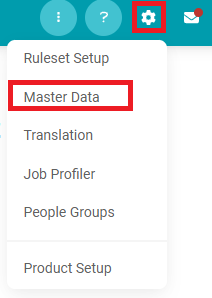
You will be redirected to the Master Data Table, where you can view existing Master Data Categories.

An indicator of the Primary Product linked to the Master Data Category is displayed, however, categories can be applied to multiple products and functions.
To view the options linked to a specific category, click on it.
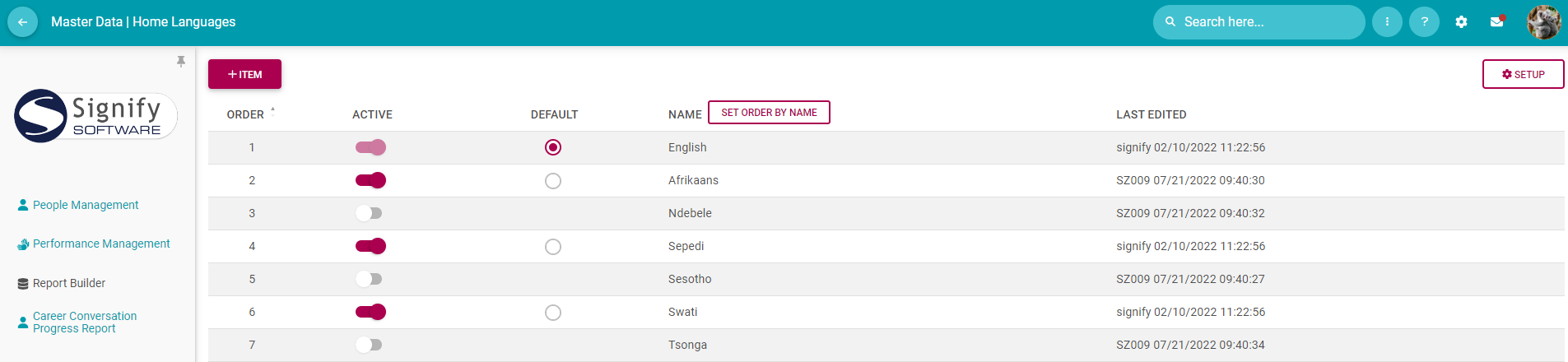
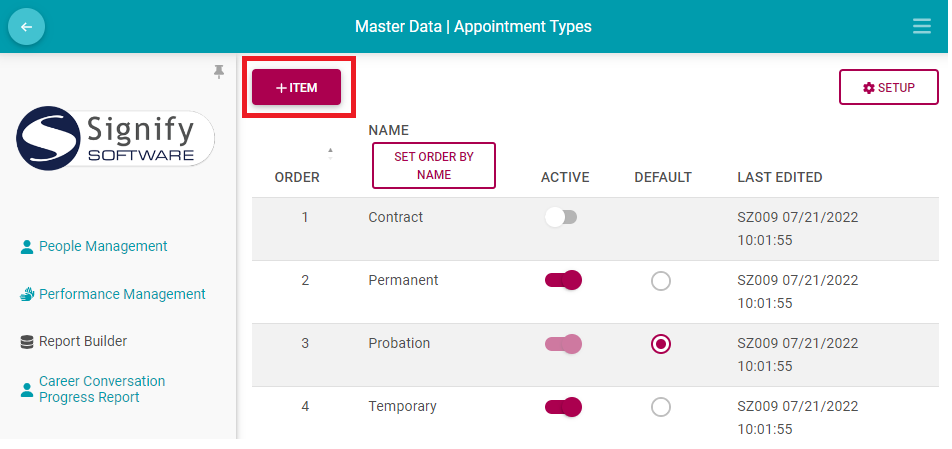
In this window, the following information is displayed:
The order in which options are displayed.
Whether the option is active or inactive.
The default option.
The name of the option that is displayed.
The date on which the option was last edited, along with the user that made the edit.
A number of adjustments can be made to the Master Data category options page, this includes:
Customising the Options table
You can customise the information displayed in the options table by clicking on the Setup button.
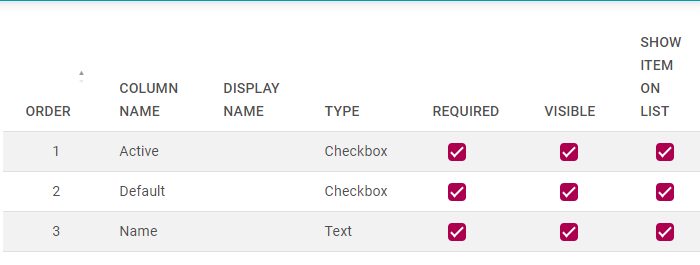
From the setup page, you can adjust the order of the columns in the options table by clicking and dragging the desired field and selecting which columns are required, visible, and shown in the options table.
Remember to click on the SAVE button before returning to the options table.
Adding Master Data Category Options
To add an option, select the category you want to modify and click on the +ITEM button in the top left corner.In this example, 'Part-time' will be added as an Appointment Type option:
A pop-up will appear on the screen, requiring you to name the category and to decide whether the option should be active and/or set as the default option. Click on the SAVE button to add your option. Once done, the option will appear in your category option table. cycles.
How do I addactivate athe personPerformance Management module?
##### **How do I activate the Performance Management module?** To activate the module: - Navigate to **Setup and Configuration** - Open **Ruleset Setup** - Select the relevant ruleset - Open the **Products** tab - Select the **Performance Management** product card - Toggle the product status to **Active** Once activated, the module becomes available for configuration.
Why can users not see the Performance Management menu?
##### **Why can users not see the Performance Management menu?** There are several possible reasons: - The module has not been activated - The system menu item is disabled - User permissions are restricted - The user is not assigned to the correct ruleset Ensure both the product and system menu item are active.
What is a review setup?
#####
HowWhat do I updateis a person'sreview reportingyear?
##### with**What is a review year?** A **review year** represents a full performance cycle for a specific year. It contains the correctreview periods, timelines, and review phases that employees and managers will follow during the performance manager?
What is dual participation?
##### **What is dual participation?** Dual participation allows both the employee and the manager to participate electronically in the performance process. When enabled: - Employees can create or contribute to agreements - Employees can complete self-ratings - Managers can submit manager ratings - Final ratings may require approval from both parties When disabled, only the manager actively manages ratings and approvals.
What are perspectives?
##### **What are perspectives?** Perspectives are the highest level of categorisation within a performance agreement. When enabled, **Key Performance Areas (KPAs)** are grouped under perspectives before KPIs are added. When disabled, KPAs can be added directly without perspective grouping.
What is a review period?
##### **What is a review period?** A review period is a weighted evaluation period within the performance cycle. Examples include: - Quarter 1 - Mid-year review - Annual review Multiple review periods can be configured within a review year.
What is a review survey?
##### **What is a review survey?** A review survey is an evaluation form used during the performance review process. Review surveys can include: - Survey questions - Scores - Weightings - Comments - Revised scores These surveys contribute to the overall performance rating.
Can managers edit review survey scores?
##### **Can managers edit review survey scores?** Yes, if the relevant setting is enabled in the review setup. When enabled, managers may update survey scores. Employees can still view the scores. If disabled, scores cannot be changed after submission.
What sections can a performance agreement include?
##### **What sections can a performance agreement include?** A performance agreement can include the following sections: - Primary Goals - Stretch Goals - Values and Behaviours - Leadership Behaviours - Key Competencies - Action Plan Only **Primary Goals** is mandatory by default.
What are Primary Goals?
##### **What are Primary Goals?** Primary Goals represent the core performance expectations of a role. They define the essential outputs and responsibilities required for effective job performance. This section is always enabled.
What are Stretch Goals?
##### **What are Stretch Goals?** Stretch Goals are optional, ambitious goals linked to innovation, transformation, or strategic growth. They usually go beyond routine job responsibilities and encourage higher-level performance.
What are Values and Behaviours?
##### **What are Values and Behaviours?** This section evaluates *how* employees achieve results. It focuses on behavioural expectations such as: - Professionalism - Collaboration - Integrity - Accountability - Communication It complements goal-based performance measurement.
What are Leadership Behaviours?
##### **What are Leadership Behaviours?** Leadership Behaviours measure leadership effectiveness and influence. This section is especially useful for senior roles and may evaluate: - Decision-making - Team leadership - Strategic thinking - Coaching - Governance
What are Key Competencies?
##### **What are Key Competencies?** Key Competencies evaluate the skills and capabilities that enable strong performance. Examples include: - Problem solving - Communication - Innovation - Technical expertise - Decision-making Competencies measure capability, not only results.
What is an Action Plan?
##### **What is an Action Plan?** An Action Plan links development activities to performance gaps or improvement opportunities. It transforms the performance agreement into a development tool by ensuring improvement actions are tracked.
Why am I getting a section weight error?
##### **Why am I getting a section weight error?** This usually happens when the combined section weights do not equal **100%**. All enabled performance agreement sections must collectively total 100%. Adjust the section weights before saving.
What is interpolation?
##### **What is interpolation?** Interpolation maps actual KPI values to a rating scale. For example, if a KPI target is numerical, the system uses the entered actual value to calculate the corresponding rating automatically.
Can non-managers rate employees?
##### **Can non-managers rate employees?** Yes, if **Allow Non-Manager Ratings** is enabled. Selected individuals other than the manager may rate employees at KPI level. This is useful for: - 360-degree feedback - Peer reviews - Project-based evaluations - Cross-functional assessments
Can non-manager evaluations be anonymous?
##### **Can non-manager evaluations be anonymous?** Yes. The system supports several anonymity options: - Fully anonymous to manager and employee - Anonymous only to employee - Hide evaluation summary from employee - Show ratings and comments anonymously This supports fair and unbiased feedback collection.
What are locked agreements?
##### **What are locked agreements?** Locked agreements prevent managers and employees from editing performance agreements. When enabled: - Agreements remain viewable - Editing is disabled - Changes require administrator intervention This helps protect finalised agreements.
What is auto-copy of objectives?
##### **What is auto-copy of objectives?** Auto-copy automatically copies objectives from the previous review period into the next review period. This saves time when objectives remain largely unchanged across review periods. The agreement status can also be copied.
What are Performance Management Section Items?
##### **What are Performance Management Section Items?** These are master data items used in performance agreement sections. Examples include: - Values - Behaviour items - Leadership items - Competency items These items can be reused across templates and agreements.
Why should I configure evaluation periods?
##### **Why should I configure evaluation periods?** Evaluation periods define the date range for reviews. They help control: - Start dates - End dates - Review timing - Rating deadlines This ensures reviews happen within the intended cycle.
Why should I use templates?
##### **Why should I use templates?** Templates make performance agreement creation faster and more consistent. Benefits include: - Standardised agreement structures - Reduced administrative workload - Faster setup - Easier scaling across teams Templates are especially useful in large organisations.
What are People Groups used for?
##### **What are People Groups used for?** People Groups allow administrators to group employees based on: - Organisational units - Reporting lines - Custom conditions - Job roles These groups help assign performance configurations efficiently.
What is the main responsibility of a Performance Management Administrator?
##### **What is the main responsibility of a Performance Management Administrator?** A Performance Management Administrator is responsible for configuring and maintaining the entire performance management environment. This includes: - Setting up review cycles - Managing templates - Configuring master data - Maintaining permissions - Monitoring review progress - Supporting managers and employees Their role ensures the performance process runs accurately and efficiently.
