
Objective-Setting Phase


When creating a performance agreement, it is important to understand the WHY. Why is it important to set objectives?
The answer is simple: to bring clarity. Having a clearly outlined goal makes it easier to achieve success.success, for managers and employees alike. For helpful tips on approaching the objective-setting phase, please visit the Before You Start page.
The following guide will help you through setting your objectives, and will assume you are using all of the following sections:sections in a performance agreement:
- Primary Goals
- Perspectives (optional)
- Key Performance Areas
- Key Performance Indicators
- Key Performance Areas
- Perspectives (optional)
- Stretch Goals (optional)
- Perspectives (optional)
- Key Performance Areas
- Key Performance Indicators
- Key Performance Areas
- Perspectives (optional)
- Values and Behaviours (optional)
- Leadership Behaviours (optional)
- Key Competencies (optional)

Below is an example of a complete performance agreement that uses all available sections.
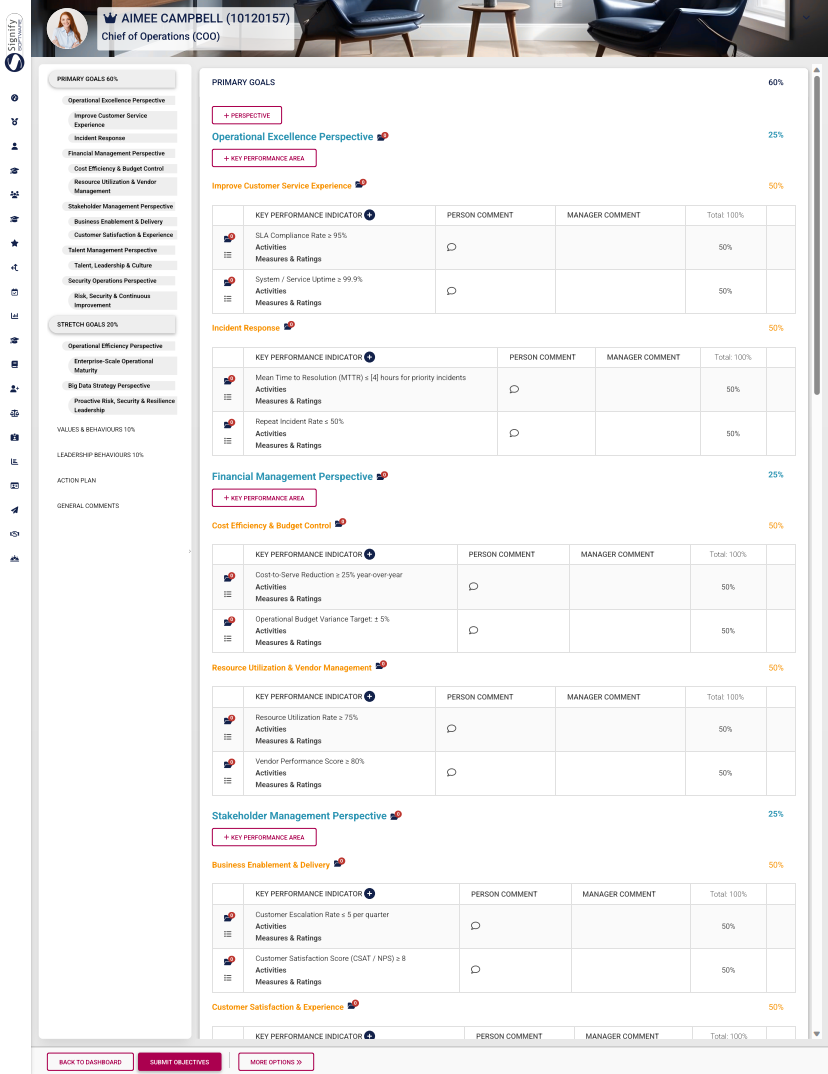
Based on your review setup, you may be using some (or all) of the aforementioned performance agreement sections. Not all sections are mandatory.mandatory. If a section (such as Stretch Goals) or a feature (such as Perspectives) does not apply to your review setup, you are more than welcome to skip itits tutorial and proceed to the next step.
EachThe tutorial for each section of the performance agreement will include aan overview flowchart outliningof the process, followed by detailed steps showing you how to complete it. Expand the following sectionscollapsible blocks to learn more.
PRIMARY GOALS
Overview

STRETCH GOALS
Overview

VALUES AND BEHAVIOURS
The objectives in this section are automatically populated when the performance agreement is created.
LEADERSHIP BEHAVIOURS
KEY COMPETENCIES
