
Objective-Setting Phase


The Objective-Setting Phase Explained
When creating a performance agreement, it is important to understand the WHY. Why is it important to set objectives?
The answer is simple: to bring clarity. Having a clearly outlined goal makes it easier for managers and employees alike to achieve success. For helpful tips on approaching the objective-setting phase, please visit the Before You Start page.
The following guide will help you through setting your objectives, and will assume you are using all of the following sections in a performance agreement:
- Primary Goals
- Perspectives (optional)
- Key Performance Areas
- Key Performance Indicators
- Key Performance Areas
- Perspectives (optional)
- Stretch Goals (optional)
- Perspectives (optional)
- Key Performance Areas
- Key Performance Indicators
- Key Performance Areas
- Perspectives (optional)
- Values and Behaviours (optional)
- Leadership Behaviours (optional)
- Key Competencies (optional)
The Performance Management module is modular and can be configured to suit your unique performance management processes. For examples of how different combinations of review setup settings work, or of different performance management configurations, please see the Tips and Use Cases chapter.

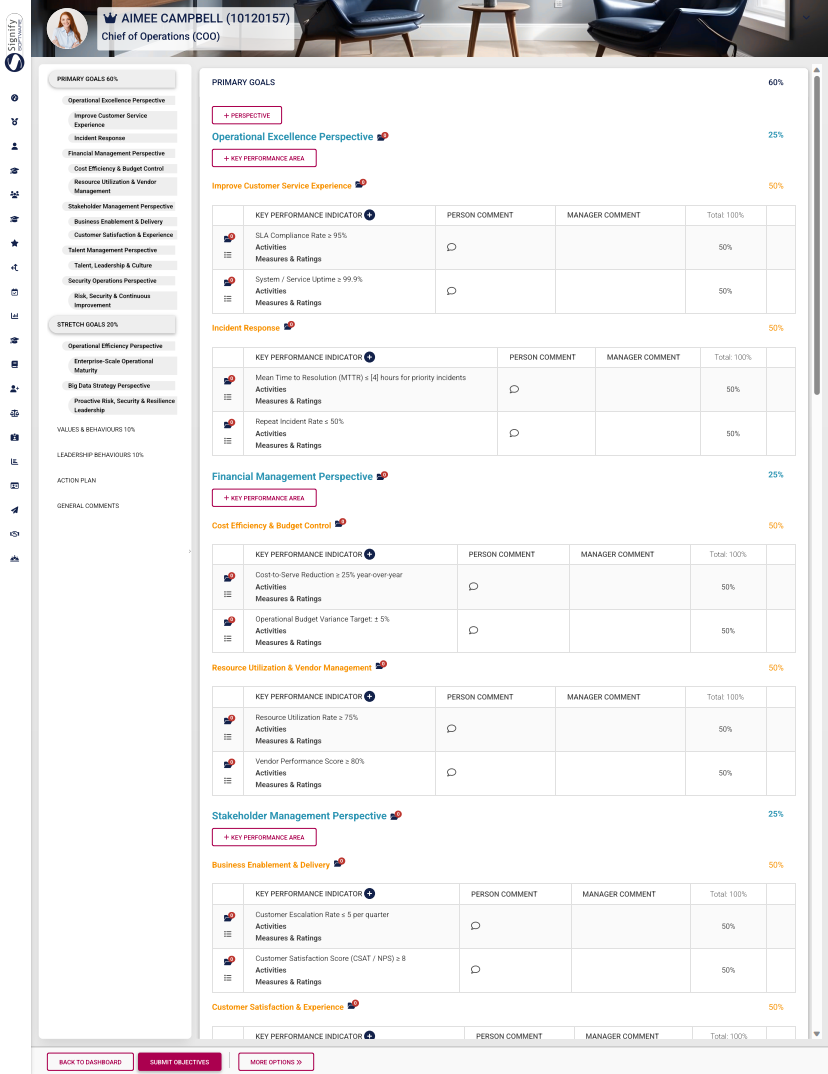
Below is an example of a complete performance agreement that uses all available sections.
- It has been populated with perspectives, KPAs, KPIs, and assigned weights.
- The side menu provides an overview of the performance agreement and allows easy navigation between its sections.
Our Example's Settings
Based on your review setup, you may be using some (or all) of the aforementioned performance agreement sections. Not all sections are mandatory. If a section (such as Stretch Goals) or a feature (such as Perspectives) does not apply to your review setup, you are more than welcome to skip its tutorial and proceed to the next step.
For our example, the following review setup settings have been enabled:
Additionally, the automatic distribution of item weights has been enabled for all settings:
The setting to add or delete items on a list (such as the Values and Behaviours list) has been disabled:
How to Complete the Objective-Setting Phase
Expand the following collapsible blocks to learn more.
PRIMARY GOALS
Primary Goals
Overview of the process

Add perspectives
- For this tutorial, we will assume you selected Create Blank when creating the performance agreement.
- The blank performance agreement will be populated with the sections that have been activated in the review setup's configuration. Please note, the red headings in the menu on the left show that information is missing, such as missing perspectives, KPAs, KPIs, or unbalanced weights. The weights of unbalanced sections will also flash red.
- Click +PERSPECTIVE to add a perspective.
- Select a perspective which has been loaded to the Master Data Library.
- Assign a weight to the perspective, then click SAVE ADD NEW to continue adding more perspectives.
- Once you have finished adding all the perspectives, your agreement should look something like this:
- Ensure all the perspective weights in this section add up to 100%.
- To delete a perspective, hover over its title, then click the dustbin icon.
- A perspective can be tagged for discussion with your manager by clicking the tag icon.
- Your manager will receive a message in their system inbox regarding your query.
- Documents linked to a specific performance agreement item can be viewed by clicking on the folder icon.
- Linked documents will display in the table on the Documents screen.
Add KPAs
- Click +KEY PERFORMANCE AREA to add a KPA.
- Either type your own KPA or select one from the Master Data Library.
- If using Master Data Library items, click on the hand icon to search for a KPA.
- Click on the KPA you would like to link.
- Assign a weight. Click SAVE ADD NEW to keep adding additional KPAs for this perspective, or SAVE if you are done.
- Ensure all the weights of the KPAs linked to a specific perspective add up to 100%.
- To delete a KPA, hover over its title, then click the dustbin icon.
- A KPA can be tagged for discussion with your manager by clicking the tag icon.
- Your manager will receive a message in their system inbox regarding your query.
- Documents linked to a specific KPA can be viewed by clicking on the folder icon.
- Linked documents will display in the table on the Documents screen.
Add KPIs
- Click the plus icon next to KEY PERFORMANCE INDICATOR to add a KPI.
- Either type your own KPI or select one from the Master Data Library.
- If using Master Data Library items, click on the hand icon to search for a KPI.
- Click on the KPI you would like to link.
- If the weights are automatically distributed (based on your review setup's settings), the KPI's weight will be calculated automatically.
- If this setting is switched off, you should assign a weight to this KPI. For more information on review setup settings, click here.
- If a rating scale has been configured on your review setup's settings, you can click to insert this pre-saved rating scale, or choose to construct your own. For more information on rating scales, click here.
- If interpolation has been activated for this review setup, you can choose to interpolate the scores of this KPI if required.
- For example, if the KPI requires selling more than 10 cars a month, you can use interpolation to calculate the scores of employees who sold 13, 20, 30, or 40 cars a month.
- During the Rating phase, you would enter how many cars were sold, and the system would automatically calculate a rating for this KPI.
- For more information on how this works, click here.
- Click SAVE ADD NEW to keep adding additional KPIs for this perspective, or SAVE if you are done.
- Check to ensure the KPI weights are balanced for this section. There are two possible settings for KPI weights:
- The Key Performance Indicator weights must add up to 100% per Key Performance Area setting is on, as shown in our example, and you need to adjust the weights accordingly (if the auto-distribute weights setting has been switched off).
OR
-
- The Key Performance Indicator weights must sum to 100% across the entire section setting is on, and you need to adjust the weights accordingly (if the auto-distribute weights setting has been switched off).
-
- If you are unsure which setting is active, please contact your performance management administrator.
- To delete a KPI, hover over it and click the dustbin icon.
- A KPI can be tagged for discussion with your manager by clicking the tag icon.
- Your manager will receive a message in their system inbox regarding your comment or query.
- Hovering over a KPI will show its activities, measures, and ratings.
- Documents linked to a specific KPI can be viewed by clicking on the folder icon.
- Linked documents will display in the table on the Documents screen.
- Click UPLOAD to upload a document linked to a specific KPI.
- Click LINK DOCUMENT to link a document from an external storage location, such as Google Drive, OneDrive, or SharePoint.
- Back on the objective setting screen, click to link an action plan to a specific KPI.
- The details of the action plan can be captured on the pop-up screen.
- If training is required for this KPI, a training intervention can be linked from the Training Intervention Library.
-
It is important to ensure your weights for this section are correct. If your weights of perspectives, KPAs , or KPIs are unbalanced, you will receive the following error message when attempting to submit your objectives:
STRETCH GOALS
Stretch Goals
Overview of the process

Add perspectives
The process for adding perspectives in the Stretch Goals section is the same as Primary Goals. Click here to jump to the tutorial.
Add KPAs
The process for adding KPAs in the Stretch Goals section is the same as Primary Goals. Click here to jump to the tutorial.
Add KPIs
The process for adding KPIs in the Stretch Goals section is the same as Primary Goals. Click here to jump to the tutorial.
For more information regarding the settings used to configure Stretch Goals, click here. Once completed, your Stretch Goals section may look similar to our example below:
VALUES AND BEHAVIOURS
Values and Behaviours
The objectives in this section are automatically populated when the performance agreement is created. For more information regarding the settings used to configure Values and Behaviours, click here.
Once completed, your Values and Behaviours section may look similar to our example below:
- If the addition or deletion of items to the list has been enabled, you may link additional items to the performance agreement. Click here to find out how to update the Master Data Library. You can hover over an item and click the dustbin icon to delete it. In our example, this setting has been disabled.
- If the auto-distribution of weights setting has been enabled, the system will automatically assign a weight to each item in the list. However, if this setting has been disabled, please ensure the weights of the items in this list add up to 100%. In our example, this setting has been enabled.
- A Values and Behaviours item can be tagged for discussion with your manager by clicking the tag icon.
- Your manager will receive a message in their system inbox regarding your comment or query.
- Documents linked to a specific Values and Behaviours item can be viewed by clicking on the folder icon.
- Linked documents will display in the table on the Documents screen.
- Click UPLOAD to upload a document.
- Click LINK DOCUMENT to link a document from an external storage location, such as Google Drive, OneDrive, or SharePoint.
- Back on the objective setting screen, click to link an action plan to a specific Values and Behaviours item.
- The details of the action plan can be captured on the pop-up screen.
- If training is required for this Values and Behaviours item, a training intervention can be linked from the Training Intervention Library.
LEADERSHIP BEHAVIOURS
Leadership Behaviours
The objectives in this section are automatically populated when the performance agreement is created. For more information regarding the settings used to configure Leadership Behaviours, click here.
Once completed, your Leadership Behaviours section may look similar to our example below:
- If the addition or deletion of items to the list has been enabled, you may link additional items to the performance agreement. Click here to find out how to update the Master Data Library. You can hover over an item and click the dustbin icon to delete it. In our example, this setting has been disabled.
- If the auto-distribution of weights setting has been enabled, the system will automatically assign a weight to each item in the list. However, if this setting has been disabled, please ensure the weights of the items in this list add up to 100%. In our example, this setting has been enabled.
- A Leadership Behaviours item can be tagged for discussion with your manager by clicking the tag icon.
- Your manager will receive a message in their system inbox regarding your comment or query.
- Documents linked to a specific Leadership Behaviours item can be viewed by clicking on the folder icon.
- Linked documents will display in the table on the Documents screen.
- Click UPLOAD to upload a document.
- Click LINK DOCUMENT to link a document from an external storage location, such as Google Drive, OneDrive, or SharePoint.
- Back on the objective setting screen, click to link an action plan to a specific Leadership Behaviours item.
- The details of the action plan can be captured on the pop-up screen.
- If training is required for this Leadership Behaviours item, a training intervention can be linked from the Training Intervention Library.
KEY COMPETENCIES
Key Competencies
The settings governing the Key Competencies section is explained here.
- Click to link key competencies to the performance agreement.
- A key competency can be selected from the Master Data Library, or you can type your own.
- Add a description, appropriate measures, and a rating scale for this competency.
- Click to activate interpolation for this item.
- Click SAVE ADD NEW to add an additional item, or click SAVE if you are done.
- Once you have completed the key competencies section, your performance agreement may look something like this:
- Documents may be linked to key competency items, as well as action plans.
ACTION PLAN
Action Plan
An action plan can be linked to a performance agreement, with actionable steps and milestones to track progress.
- To create an action plan, click +ACTION. A previous action plan item may also be copied to the current performance agreement.
- The details of the action plan can be captured on the pop-up screen.
- If training is required for this action plan, a training intervention can be linked from the Training Intervention Library, or you may type your own.
GENERAL COMMENTS
General Comments
General comments, from the employee as well as the manager, can be made on the performance agreement. Click +GENERAL COMMENT to add a new comment.
Submitting a Performance Agreement
