
Signify Payroll Connector for Sage
This document describes the integration process between Signify (V10) and SAGE 300 People with a specific focus on the API integration.
General business rules:
- In this case, SAGE is the source of the basic employee information.
- The integration job will be executed on the Signify V10 system and is usually scheduled to run during the night.
- Signify calls the SAGE APIs to obtain a bulk dataset with multiple fields and all employee records.
- If the expected record count of the dataset is expected to exceed 5,000, please liaise with a technical Signify consultant.
- Some of the fields in the dataset may be empty due to the fields not being populated in SAGE:
a. In such cases:
i.These fields can be maintained on the Signify system
ii. Left blank, as the client may not require it
b. If preferred, the client may choose to purchase additional modules in SAGE to maintain such fields in SAGE. It is, however, not a requirement as such fields can be maintained in Signify.
c. Example: If OFO codes are required, the Skills module in SAGE is required, alternatively, these values can be maintained on the job profile in Signify.
Process business rules:
The integration process architecture is depicted in the image below:
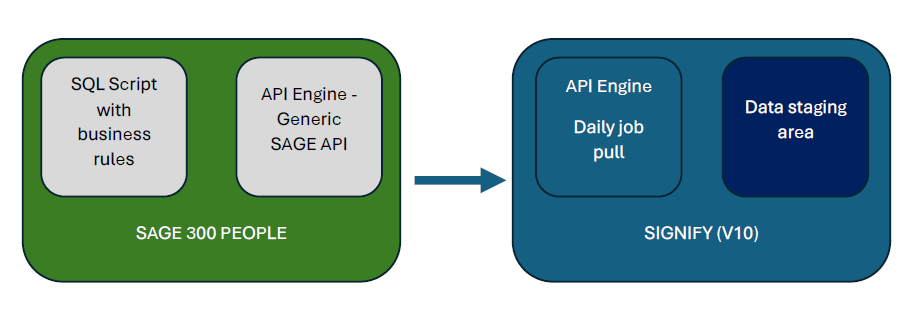
- The integration process that is executed by the Signify system calls an API on the SAGE server to retrieve a dataset with all the employee records from SAGE.
- This dataset includes active employee records, as well as employee records for employees who were terminated during the previous [TBD] months.
- Optional: An option to provide a parameter to only return records that were changed in the last [X] days will help to limit the size of data to be pulled during the API request. This option must, however, allow for all records to be pulled.
- This dataset is stored in a staging table in the Signify system, from which the data transformation is done:
- Employee number is used as the unique identifier and is used in the [EmployeeCode] and [Username] fields in Signify, where [Username] must be unique.
- If an employee number does not exist in Signify (in the [Username] field), a new record is created in Signify.
- If an employee number exists, the existing record is updated in Signify.
- If Job and Position codes are available from SAGE:
- If a job code and position code do not exist in Signify, a new job profile and linked position title are created in Signify.
- If Job and Position codes are NOT available from SAGE:
- If a job title and position title do not exist in Signify, a new job profile and linked position title are created in Signify.
- This may cause unused job profiles to remain in Signify and may have to be cleaned up manually.
- If Organisation unit codes are available in SAGE:
- If an organisation unit does not exist in Signify, a new organisation unit is created in Signify.
- The above means that all new appointments, terminations, and movements are made.
For additional information regarding the SAGE 300 People APIs:
http://documenter.getpostman.com/view/7078460/UVRBn6LC#db6e0efe-8d5d-4e1b-b0e7-c6de98410295
Who to involve:
- A Signify technical consultant will ensure that the above process is implemented from a Signify point of view.
- A SAGE technical consultant (usually a SAGE channel partner) must configure the API on the SAGE hosting environment.
- SAGE clients can choose if the way to use their channel partners to configure the necessary API process.
- Alternatively, Signify can connect the client or their channel partner with a SAGE technical consultant that Signify has partnered with on previous projects, and who can implement the process within a time effort of between 2 and 6 hours.
- The consultant will deploy a custom SQL script on the SAGE database.
- An SSL certificate must be purchased by the client and configured by the SAGE consultant.
- The SQL script is executed when the Generic SAGE API is called.
- The API is: http://{{HostName}}:{{APIPort}}/api/apibase/GenericGet/{{GenGetCodeAsSetupInPeople}}
- Below is the list of fields that are required and recommended. Fields with no comments are optional. To ensure complete information, even fields with no comment should be added if available in SAGE:
Field Name |
Field
|
Description |
Mandatory
Required/Optional/ ESS Configured
Required / Recommended / Notes(If blank, optional)
ESS Configured
ESS Configured
ESS Configured
ESS Configured
ESS Configured
Optional
Optional
Optional
Optional
Optional
Optional
Required when any residential field supplied
Required when any residential field supplied
Optional
Optional
Optional
Optional
Optional
Optional
Optional
Optional
Required when any postal field supplied
Required when any postal field is supplied
Optional
Name ResidentialCountryof the job
NOptional
startDateInCompany string The start date in the company within the group Optional
orgLevel1_externalId Int Org unit Id on payroll Optional Recommended if available in SAGE orgLevel1_name string
Required Required – can be hardcoded if not available in source system orgLevel1_code string Unique code per ruleset for org unit Optional Required orgLevel1_workLocationName string
Optional Recommended if the client has this level in the org orgLevel2_externalId Int Org unit Id on payroll Optional Recommended if the client has this level in the org orgLevel2_name string
Optional Recommended if the client has this level in the org orgLevel2_code string Unique code per ruleset for org unit Optional Recommended if the client has this level in the org orgLevel2_workLocationName string
Optional
orgLevel3_externalId Int Org unit Id on payroll Optional Recommended if the client has this level in the org orgLevel3_name string
Optional Recommended if the client has this level in org orgLevel3_code string Unique code per ruleset for org unit Optional Recommended if client has this level in org orgLevel3_workLocationName string
Optional
orgLevel4_externalId Int Org unit Id on payroll Optional
orgLevel4_name string
Optional Recommended if client has this level in org orgLevel4_code string Unique code per ruleset for org unit Optional Recommended if client has this level in org orgLevel4_workLocationName string
Optional
orgLevel5_externalId Int Org unit Id on payroll Optional
orgLevel5_name string
Optional Recommended if the client has this level in the org orgLevel5_code string Unique code per ruleset for org unit Optional Recommended if the client has this level in the org orgLevel5_workLocationName string
Optional
orgLevel6_externalId Int Org unit Id on payroll Optional Recommended if the client has this level in the org orgLevel6_name string
Optional Recommended if client has this level in org orgLevel6_code string Unique code per ruleset for org unit Optional Recommended if client has this level in org orgLevel6_workLocationName string
Optional
orgLevel7_externalId Int Org unit Id on payroll Optional Recommended if the client has this level in the org orgLevel7_name string
Optional Recommended if the client has this level in the org orgLevel7_code string Unique code per ruleset for org unit Optional Recommended if the client has this level in the org orgLevel7_workLocationName string
Optional
orgLevel8_externalId Int Org unit Id on payroll Optional Recommended if the client has this level in the org orgLevel8_name string
Optional Recommended if the client has this level in the org orgLevel8_code string Unique code per ruleset for org unit Optional Recommended if the client has this level in the org orgLevel8_workLocationName string
Optional
orgLevel9_externalId Int Org unit Id on payroll Optional Recommended if the client has this level in the org orgLevel9_name string
Optional Recommended if the client has this level in the org orgLevel9_code string Unique code per ruleset for org unit Optional Recommended if the client has this level in the org orgLevel9_workLocationName string
Optional
lineManagerUsername string The username of the manager, existing in the system or part of the API body Optional
performanceManagerUsername string The username of the manager, existing in the system or part of the API body Optional
departmentManagerUsername string The username of the manager, existing in the system or part of the API body Optional
trainingManagerUsername string The username of the manager, existing in the system or part of the API body Optional
pdpFirstApproverUsername string The username of the manager, existing in the system or part of the API body Optional
pdpSecondApproverUsername string The username of the manager, existing in the system or part of the API body Optional
leaveManagerUsername string The username of the manager, existing in the system or part of the API body Optional
salaryReviewManagerUsername string The username of the manager, existing in the system or part of the API body Optional
talentManagementManagerUsername string The username of the manager, existing in the system or part of the API body Optional
secondaryReportingManagerUsername string The username of the manager, existing in the system or part of the API body Optional
lineManagerOnceRemovedUsername string The username of the manager, existing in the system or part of the API body Optional
workflowOriginatorUsername string The username of the manager, existing in the system or part of the API body Optional
financeManagerUsername string The username of the manager, existing in the system or part of the API body Optional
financeOfficerUsername string The username of the manager, existing in the system or part of the API body Optional
hrOfficerUsername string The username of the manager, existing in the system or part of the API body Optional
hrRecruitmentOfficerUsername string The username of the manager, existing in the system or part of the API body Optional
businessUnitHrManagerUsername string The username of the manager, existing in the system or part of the API body Optional
secondaryJobRequisitionApproverUsername string The username of the manager, existing in the system or part of the API body Optional
leaveManagerAlternateApproverUsername string The username of the manager, existing in the system or part of the API body Optional