Learner Roles

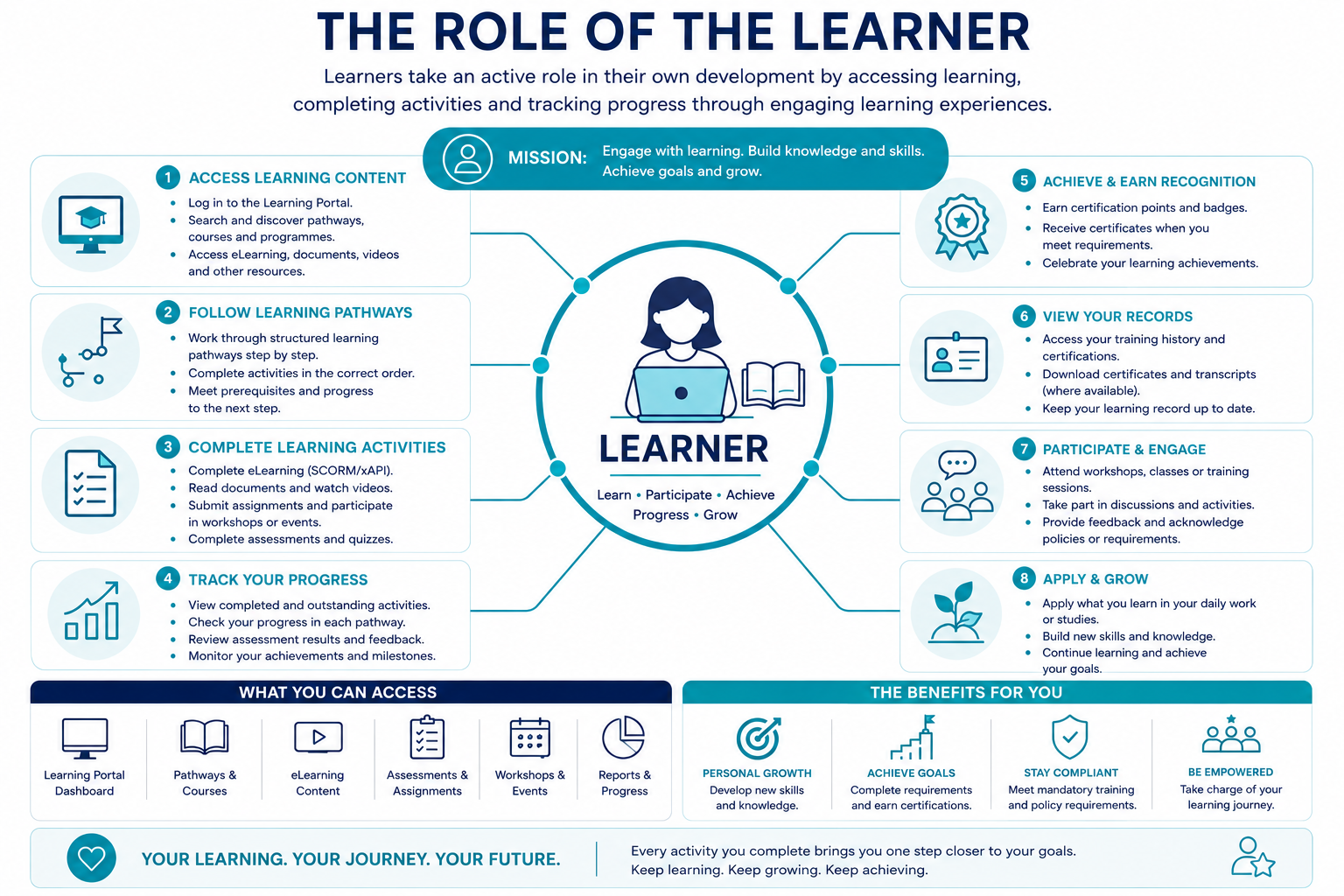
A learner’s role within the Learning Management module is interactive, self-directed, and development-focused, centred around participating in learning activities, completing training requirements, and tracking personal progress.
Access learning content and pathways
Learners use the Learning Portal to access training material, eLearning pathways, academic subjects, and development programmes assigned to them.
They can:
- Search for learning content,
- Access published pathways,
- Open eLearning programmes,
- Navigate structured learning journeys, and
- Participate in assigned training activities.
Complete learning activities
Learners engage with the various pathway steps and activities configured by administrators.
Depending on the pathway setup, learners may:
- Complete SCORM or interactive eLearning modules,
- Download and study documents,
- Watch videos,
- Attend workshops or training events,
- Submit assignments,
- Complete online or practical assessments,
- Provide responses or feedback,
- Accept terms and conditions, and
- Achieve certification points or milestones.
Track personal learning progress
The Learning Management module allows learners to monitor their own progress and training activity throughout their learning journey.
Learners can:
- View pathway progress,
- Monitor completed and outstanding activities,
- Access learner records,
- Review assessment outcomes,
- View certifications and training history, and
- Track personal development achievements.
Participate in assessments and evaluations
Learners complete assessments, quizzes, assignments, and evaluations to demonstrate understanding and competency.
This may include:
- Online assessments,
- Practical evaluations,
- Assignment submissions,
- Workshop participation,
- Academic activities, and
- Certification requirements.
Engage in self-directed learning
The module supports flexible, self-paced learning, enabling learners to complete training in line with organisational requirements and personal schedules.
Learners can:
- Access content remotely,
- Return to incomplete pathways,
- Redo permitted activities,
- Study supporting material at their own pace, and
- Continue learning across multiple devices and sessions.

Participate in academic and online school environments
Within the Online School environment, learners can participate in structured academic activities and engage in classroom activities.
This includes:
- Accessing subject pathways,
- Completing academic assessments,
- Viewing marks and progress,
- Tracking attendance,
- Accessing report cards,
- Taking private class notes, and
- Participating in virtual classroom activities.
Maintain learner accountability and compliance
Learners play an important role in ensuring that mandatory learning activities, compliance training, acknowledgements, and certifications are completed accurately and on time.
This includes:
- Completing required training,
- Acknowledging policies and procedures,
- Meeting assessment requirements,
- Participating in scheduled learning activities, and
- Maintaining up-to-date learner records through participation.
Engage with facilitators and learning processes
Depending on the learning environment, learners may interact with facilitators, educators, managers, or administrators throughout the learning process.
This may include:
- Receiving feedback,
- Participating in facilitated training,
- Submitting coursework or assignments,
- Attending workshops or classes, and
- Communicating through pathway activities or learning interactions.