
How Learning Management Works

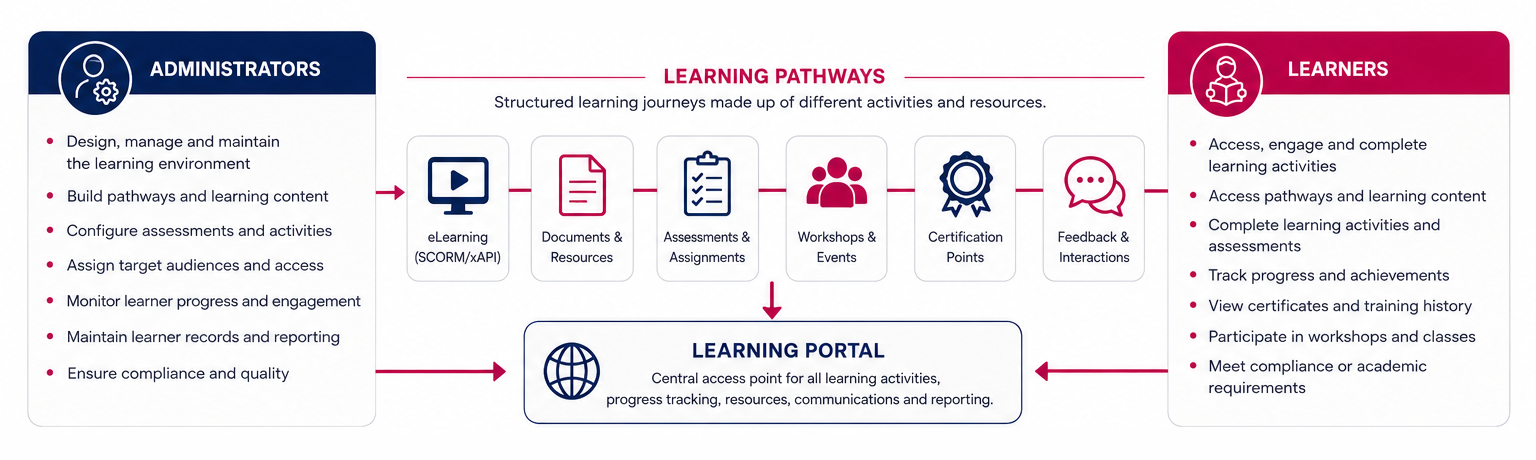
Learning Management is a connected ecosystem that supports creating, delivering, managing, and tracking learning activities across an organisation or academic setting.
Administrators establish and oversee the learning framework by designing pathways, setting up learning materials, handling assessments, assigning target groups, and keeping learner records up to date.
The module uses pathways as the foundation of the learning experience. A pathway is a structured sequence of learning steps designed to guide learners toward a specific outcome, such as completing onboarding, achieving a certification, attending training, completing compliance requirements, or participating in academic learning activities.
Administrators organise these pathways into structured categories and control how learners access them by target audience or academic class. This ensures that learning content is delivered to the correct individuals while maintaining governance and visibility across the learning environment.
Learners then interact with the learning environment by accessing pathways, completing training activities, participating in assessments, and progressing through structured learning journeys.
Learners access these pathways through the Learning Portal, where they can complete activities, monitor progress, review their training history, and learn at their own pace. As learners complete pathway activities, the system automatically tracks progress, logs learner records, records certifications, and updates assessment outcomes where applicable.
The relationship between the Learning Administrator and the learner is collaborative and interdependent.

Learning Administrators are responsible for:
- Designing and maintaining the learning environment,
- Managing learning content and pathways,
- Configuring assessments and training activities,
- Monitoring learner participation and progress,
- Managing learner access and permissions,
- Supporting compliance and reporting requirements, and
- Ensuring learning content remains accurate, engaging, and relevant.
Learners are responsible for:
- Participating in assigned learning activities,
- Completing required pathway steps,
- Engaging with learning material and assessments,
- Monitoring their own progress and development,
- Meeting compliance or academic requirements, and
- Contributing to successful learning outcomes through active participation.
To learn more about implementing the Learning Management module, proceed to the next chapter.
